
What is Ginseng? 
Several herbs are commonly called ginseng but the two most famous are American/ Canadian ginseng (Panax quinquefolius) and Asian ginseng (Panax ginseng), which becomes one of the most famous medicinal herb in Asia. "Chinese ginseng" and "Korean ginseng" are both Panax ginseng. Rather than just being dried after harvest, Korean ginseng, also commonly known as red ginseng, is being steamed and dried, giving its red distinctive color and altered medicinal functions.
Medicinal use of ginseng can be tracked back for nearly 2000 years in China. Since after North American ginseng was introduced to China around 300 years ago, it has been tested and widely used as an ingredient for traditional Chinese medicine.
The Yin and Yang concept views the world as a balance between two opposite and complementary forces. Yang is consider to be a "hot" force where it is more "active and issuing"; Yin is consider to be a "cooling" force where it is more "passive and receptive". This theory has strongly influenced traditional Chinese medicine. In the body, a balance should be maintained between the Yin and Yang forces, and illness is a result of its imbalance. In traditional Chinese medicine, North American ginseng is more Yin, meaning it is used to reduce "heat" in the body; whereas Asian ginseng is more Yang, meaning it is used to raise 'heat" in the body. Their applications thus differ and are complementary, they also have different medicinal effects.
(*Note that in the context of traditional Chinese medicine, words like "heat", "hot", and "cooling" does not have the same connotation as it does in plain English.*)
As Asian ginseng is more Yang, it is considered to have a "stronger" force, and it is usually being consumed when needed during illness. Whereas American/Canadian ginseng is more Yin, so it is considered to have a "milder" force, and can be consumed daily to improve health.
So what kind of traditional Chinese medicine is North American ginseng?
Why does it possess such magic power?
Although North American ginseng was discovered by Westerners and brought to China in the 1700's, its medicinal effect and clinical applications were initiated by Chinese people, and has been used as a Traditional Chinese Medicine since then.
North American ginseng differs from Asian ginseng, with respect to their Yin and Yang nature. North American ginseng has a cooling and nourishing nature with no "dryness-heat", so it can be used to treat people with "heating symptoms". It works especially well in treating people with high heating symptoms and imbalance of both qi (inner energy) and body fluids.
Renewed Materia Medica, published during the Qing Dynasty, clearly explains the effects of North American ginseng. It states that “North American ginseng is bitter and sweet in taste and cooling by nature with non-toxic characteristics”. North American ginseng nourishes the lungs and lowers the fire, it also relieves fatigue and works best for people with inner heat etc.. This shows that in ancient China, people already had a very profound understanding of North American ginseng.
The effective components of North American ginseng include ginsenosides, polysaccharides, amino acids and many other trace elements. Among these elements, ginsenosides is the most effective component of North American ginseng, of which about 5 to 10% is contained within. Medical specialists have found that ginsenosides are the foundation for the many therapeutic effects of North American ginseng.
To date, scientists found the list of ginsenosides in Canadian ginseng includes Rb1, Re, Rd, Rg1, Rg2, Rg3, Rc, Rb2, Ro and Rb3. Steaming or boiling ginseng can alter chemical structures of the ginsenosides, for example, ginsenosides Rg2, Rg3, Rh1 and Rh2 etc. would then account for most of the ginsenosides content. Ginsenosides can be divided into two main groups: protopanaxadiol (PPD) and protopanaxatriol (PPT). Group PPD includes Rb1, Rd, Rc, Rb2, Rg3 and Rb3; whereas group PPT includes Re, Rg1 and Rg2.
Rb1 can relieves heat and pain. It exerts many effects on the human body. It can work as a tranquilizer to cure insomnia, help boost memory and protect our neurons, prevents arteriosclerosis, regulates blood sugar level, increases the effectiveness of the immune system and lowers cholesterol.
Re can help decrease blood glucose, cholesterol, and triglyceride levels as well as decrease oxidative stress in our organs. Thus it can help prevent diabetes in healthy people and improves blood glucose level control in type 2 diabetes patients.
Rd has protective effects on neurodegeneration, and also function as an antioxidant.
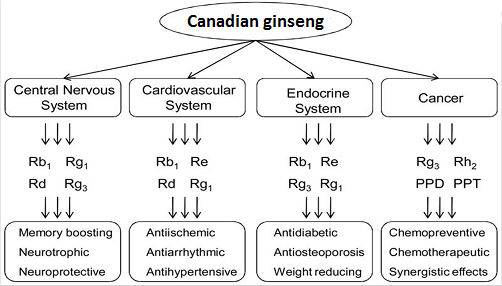
Rg1 acts as a stimulant to the central nervous system, it can improves learning and memory acquisition, consolidation, and retrieval. Rg1 also can dissipate fatigue effects. In addition, Rg1 helps prevents cardiovascular and cerebrovascular disease by preventing thrombosis and regulating blood pressure etc., It also help prevents the deterioration of sexual functions, strengthens the immune system.
The following figure illustrates some of the effects:
Polysaccharides have prominent effects in fighting cancer, or act as an antineoplastic agent. These polysaccharides induce the production of IFN-γ in the presence of concanavalin A. And they induce the production of significant amount of TNF-α in cells. TNF-α (Tumor necrosis factor-α) plays roles in antitumor activity, immune modulation, inflammation, anorexia, cachexia, septic shock, viral replication, and hematopoiesis. TNF-α is expressed by a variety of cells, with numerous inductive and suppressive agents. It is primarily produced by macrophages in response to immunological challenges such as bacteria, viruses, parasites, mitogens, and other cytokines. TNF-α is cytotoxic for many transformed cells, but in normal diploid cells, it can stimulate proliferation (fibroblasts), differentiation (myeloid cells) or activation (neutrophils). TNF-α also shows antiviral effects against both DNA and RNA viruses and it induces production of several other cytokines.
Amino acids can boost the synthesis of many nucleic acids and proteins. When the human body lacks a specific amino acid, both men and women are likely to suffer from further complications.
In addition, North American ginseng has many trace elements that are essential to the human body. These trace elements are usually the active elements of all types of enzymes that the human body needs, which are extremely important for the body's metabolism. According to literature, these trace elements include calcium & phosphorous that can treat osteomalacia and osteoporosis; Cobalt, copper and iron can prevent anemia and other hematological diseases; Zinc can prevent hypertension and works as an anti-aging, anti-tumor agent; Manganese, barium and germanium can prevent cancer and combat cancer.
Overall, North American ginseng contains different elements that work collaboratively to complement with each other in order to achieve therapeutic effects far beyond than what these elements can achieve on their own.
Currently, the therapeutic effects of North American ginseng are widely recognized by experts from all over the world. It can be used to treat people with hypertension, cardiovascular disease, diabetes, insomnia, stomach ulcers, hepatitis, chronic fatigue syndrome, asthma, allergies and to boost the immune system etc.. North American ginseng's effects are multi-faceted, for example, it works perfectly in either way to adjust blood pressure, for both hypertension and hypotension.